Mouth Music – refreshing the parts that other musics rarely reach.
In the rehearsal studio, the choreographer’s rhythmic vocalisations and gestures direct the dancers’ moves:-
“Ha!” flops forward from the waist
“Boom!” upright, legs apart, shoots right hand index finger to the sky
“Va-a-ah” finger arcs down to the floor
“Rrr-rrr-Ah” upright – hands on knees
“Vr-rra-Ha” contraction and roll up the spine, snap head up
“Uh-ha-rrrhur-Ha-Ah” repeats contraction and roll up slower
“Fff-ooo” (with hand clap) snap head to look right
“Wuhh” (on the in breath) hold
The intimate direct transfer of idea, timing, energy and intent through the sound is mesmerising, spell binding. It is so clear, so targeted, so explicit in the dynamic relationship between the two.
Later in the documentary, we see the finished piece, (Ulysses Dove’s “Vespers” from “Dance in America - Two By Dove”, Dir. David Hinton, in the 1995 Great Performers Series), it is impressive, slick, fast paced, performed flat out with total commitment on the part of the dancers – but now the vocal sounds that had been so extraordinary in the rehearsal process are replaced with a soundtrack of kit drums played with sticks. They are loud and have energy – but without any of the nuances, without the dynamics and the dynamic interplay that were so special in the rehearsal. I’m gutted, outraged, stunned! I can’t believe it. What happened? Why? Where are those vocalisations? We’ve lost the direct connection between sound and dance, we’ve lost the fluidity and subtlety of the relationship – actually we’ve lost the relationship itself. It seems such a shame, such a missed opportunity. I can understand that the choreographer might not want to have to make those sounds himself for the performance, that he might feel his job is to choreograph not to vocalise, that the soundtrack is supposed to be made by musicians; but then surely there must be a way to get the same life, that he has worked so hard to inject into the dance itself, into the sound that is used, to find a way of translating the energy and intent of those sounds into the soundtrack. The drum track has none of the drama of the vocalisations. It doesn’t breathe – literally, it doesn’t breathe; we hear the voice making certain sounds on the in-breath, creating a sense of suspension and anticipation as the dancers suspend for a moment and we become aware of their breathing, also taking an in-breath ready to go again. By contrast the drumming powers its way through regardless, it doesn’t breathe, either on its own or in relationship with the dancers. It fills every bit of the available audio space to create a wall of sound against which the dance takes place. It has become a backdrop which, rather than reinforcing and highlighting the dancers’ movements and drawing us in to them, has the effect of distancing us from them, pushing us back into becoming distant spectators rather than intimate confidants. The vocalisations had highlighted the dynamic flow in the energy being projected out by the dancers; energy thrown outwards – caught again, gathered – held, suspended – ready to erupt again. The filling of every beat by the drums and their constant unwavering dynamic level means we lose the sense of how the energy is being used and as a consequence our perception of the dance, especially our intrinsic, instinctive corporeal reactions to the physicality of the dancers moving in the space is dulled and diminished. It is still a brilliant piece of dance but it could have had so much more!
For me music is all about relationship. Years ago, as part of my education, I was asked to write an essay on the “elements of music”. This phrase is generally used to refer to such things as pitch, melody, rhythm, harmony, tone, and while these can be important as ways of thinking about and analysing different musics and musical styles, as I looked into it I felt there were much more fundamental and essential elements. At its core, it came down to these three – Sound , Silence and Relationship. Over the intervening years I have more and more come to see the relationship element as absolutely crucial to music and music making. There are many layers to this idea of relationship. The relationship between the sounds, and between them and silence is obviously crucial. Their relationship comes into focus through the surrounding, enveloping silence, it is what gives them definition and meaning. We begin from silence and return to it at the end of a piece and within the silence there seems to be the potential for all manner of expression. Without its punctuating presence, without the aural space we loose the sense of the music. This seems to be what was happening in the soundtrack for Ulysses Dove’s “Vespers”. Is it going too far to suggest that it is this sense of relationship that makes the difference between noise and music?
In terms of the practice of music making, firstly there is the relationship of the player to their instrument or voice, developing this facility through years of practice so as to be able to create an expressive channel with which to work. Then comes the relationship of the player to the musical material, learning the specifics of the material whether that is pre-composed or improvised, finding and understanding the internal relationships within it, making the music “one’s own”. Then there is the relationship to the other musicians one plays with, listening to each other’s voices, finding how to function together. This goes far beyond simply putting the right notes together at the right time. Understanding the roles in the relationship, when to be on top, when underneath, when to lead, to follow, to support, when to push, when to hold back. Finally once all those essential relationships are in place and functioning, there is the possibility of a relationship to the audience. On a “good night” the audience lend their support to the musicians, offering them their energy and actively willing them to do something special with it. Conversely, on a “bad night” they withhold that support and energy, making it almost a battle, a confrontation, effectively sitting back with arms folded saying “Go on then! If you’re so great, prove it, show us what you’ve got”, making the musicians work extra hard to win them over and forge a relationship.
A really striking example of a brilliant symbiotic relationship between musicians is found in a collaboration between Inuit throat singer Tanya Tagaq and Iranian music producer Ash Koosha, in a session they made together for Radio 3’s “Late Junction” programme. (23 Feb 2017). Excited and inspired by what I had heard I went searching for music by each of the performers. Interestingly their individual recordings had nothing of the depth and drama of the collaboration, each of their own works were competent enough, nicely produced, but they stayed neatly within the clearly defined boundaries of their respective musical genres, lacking the dynamic flowing interplay that characterised their joint session. Their collaboration had provoked each to produce something with far more depth, more individual personality, wilder and more expressive energy than either produced on their own. Together they produced 3 tracks that were unique, highly personal, dynamic and alive, finding sounds, expressions and phrases that made the hairs on the back of my neck stand up. In her vocalisations the singer sounded as though she had reached deep down inside, both of herself and her vocal and cultural tradition, tapping into primeval, existential impulses and giving them expression. Her accomplice, for his part, had found sounds to both inspire and encourage her in this exploration of the depths, and to accompany, support and reinforce those expressions that she brought to the surface and made manifest.
I became a musician largely because as a result of repeated use of hallucinogens in my youth, I spent several years barely talking to anyone. I remember clearly witnessing what I was trying to communicate and simultaneously, as if looking from outside, seeing and hearing how it sounded and the meaning that was conveyed across the space and how the two were different. The intended expression from inside and its received perception from outside didn’t match and I ended up tying myself in ever tighter knots trying to backtrack, unravel the confusion and explain what I actually meant. Now with several decades distance from the experiences, I can no longer be certain how objectively accurate that drug induced perception was. At the time it felt absolutely real, that there was an immense gulf between the words issuing from my mouth and the sense that I was attempting to convey. There seemed to be so many layers to it that it became a downward spiralling tunnel, and I basically stopped talking for a number of years. In this anxious, cut off, limbo like state, playing music became for me a way of being with other people, of being connected and part of a group without having to talk or make conversation. So I became a musician, not because of any innate musical talent, I certainly couldn’t do any of the normal musical things one is supposed to be able to do, I could barely distinguish higher and lower pitches, couldn’t sing even the simplest melody, and even now I find recognising the same note played on different instruments extremely problematic. Despite now understanding that the labelling refers to a very small portion of the note, namely the lowest component of its frequency spectrum, “Middle C” on a piano and on a violin are such vastly different sounds that to call them both “Middle C” seems in no way to correspond with the aural reality I hear. I also feel it is related, that in my teens, someone pointed out to me that when I tried to sing, if the melody went up or down I didn’t actually change pitch but attempted to follow it by changing the tone or timbre of what I was singing, making it more tinny if the pitch went up and more bassy if it went down, rather than actually changing the pitch of the note.
Later I trained as a music therapist and worked with, amongst others, pre-school children with communication difficulties. In retrospect I can see that in my training and work that I probably should have tapped into my experiences of not talking far more. I really didn’t recognise and consider the significance of them at the time, I was probably still too close to them and it was probably still too raw, I was just surprised and immensely relieved to be finally emerging from that state. I think if there had more been direct processing of that material as part of the training process that would have been a really valuable thing. In the weekly counselling sessions we undertook we did deal with people’s ongoing issues, but it usually meant dealing with any immediate pressing problems rather than probing more deeply into what had brought each of us to that point, and what as a result, we brought in terms of experience and insights to the process of learning to become music therapists. This should actually be a very important part of training I feel, asking the pertinent questions “What has brought you to this point? Why do you want to be a therapist? What’s in it for you? What are your own therapeutic issues? What particular qualities could you bring to this work?”
One day whilst hitch hiking I had a lift with a naval officer and as part of the conversation we ended up talking about our Desert Island Discs where, like the original Radio 4 programme, we each chose a number of musical tracks and talked about why they were particularly special and personal to us. (The original programme’s format was to choose eight tracks and at the end select the one which you would keep if you could only have one). Since then I have used this idea a number of times both with students as a way of getting to know something about them musically, and also with other musicians, swapping CDs of our tracks to give more insight into each other’s musical leanings. I noticed that the first time I did it only one out of the 8 tracks I selected was a vocal track, more recently I have been revisiting them and noting how I am now drawn to far more vocal tracks. Having always been only really interested in instrumental music, (for years my music collection was probably 95%, maybe more, instrumental), I started to discover the voice, firstly as a functional vehicle – imitating instrumental sounds when explaining a musical passage or understanding an acoustical phenomenon such as where the various EQ bands one used were located in the audible spectrum and later as an extraordinarily expressive vehicle. There is something extraordinarily important and special about vocal sounds. They have the potential to reach deep into our inner worlds, to tap into more elemental feelings and emotions and to give those expression and resonance. Natalie Haynes in her wonderfully funny and well researched radio series ‘Natalie Haynes Stands up for the Classics’ says that “It’s a recurring theme in (Ovid’s) ‘Metamorphoses’ that when people lose power they lose their voice”.
Even when they are imitating instrumental musical sounds, there is often a fascination for us in the vocal imitation that isn’t there in the original sound. There are a great number of musical traditions where the voice is used in imitations of instrumental sounds and music, both as teaching and learning aids, and as forms of performance in their own right. The Celtic musical traditions of Scotland and Ireland for instance have Diddlin’, Lilting, Canntaireachd and Puirt-a-Beul
A few years ago I went to the funeral of an old friend, it was a fairly “alternative” funeral, quite informal without any sense of a traditional religious service or any other clear ceremony. We gathered in the crematorium, a few family members and friends got up and said appropriate words and then we filed out past the coffin, but somehow it felt lacking in something. I came out at the end with the really strong feeling, “there was no singing, there should have been singing”. I felt that we needed a vehicle to put the unspoken emotions into, to bring us together, to give us a sense of close connection, a way to coalesce together and channel our feelings. It felt as though there had been a reaction against the religious ceremony as old fashioned and inappropriate, but that in throwing that out they had also thrown out an essential element that was there for a really concrete, down to earth, tangible reason. We needed to sing, we needed that space to individually and collectively express ourselves. It didn’t have to be hymns, it didn’t have to have a religious aspect, though for perhaps the majority of people, most times it probably naturally will have that aspect. It almost certainly should have more thought put into planning it than it often does, and having someone to lead the singing, finding appropriate accompaniments, create the space for it to happen in and actively supporting the congregation in their collective expression is really important. Perhaps we need a choir or a strong vocalist who can musically hold our hands and actively guide us through the process, encourage us to find our voice, especially for those of us who don’t usually sing when anyone is around or who don’t know the hymns or songs being sung. Even something as simple as really clear introductions, making the tune, the starting note and the keynote unmistakably obvious would be immensely helpful! It may be that we need to find a whole new form of collective, participatory vocal expression for such occasions. In many cultures there are traditions of professional mourners or wailers, the Irish tradition of Keening is an example of this.
It can be hard to go against tradition and perceived expectations. When arranging my mum’s funeral I was very clear that there should be singing and that we should have the hymn “Guide me O thy Great Redeemer” more commonly referred to as “Bread of Heaven” with the tune “Cwm Rhondda”. Really I wanted to have it sung with the words that I had heard her and my aunt sing during my childhood, relating to the shops and pub in the street in Cardiff where they and my grandmother had lived, this meant replacing the chorus with:-
“ Bread from Evan’s - es, Tea from Phillip’s - es,
Bee - er from the Dusty Forge,
Dusty Forge,
Bee - er fr - om th - he Dus-ty Forge”.
In the end I didn’t have the courage of my convictions and opted for playing safe, just having the hymn with its usual words. I wasn’t confident that I could carry it off, or that the rest of the congregation would go for it, so kept the hymn’s traditional chorus rather than risking awkwardness or disapproval.
Animation from Lockdown
Re-wilding is Happening Close to Home
On my way home from a funeral recently I dropped one of the mourners off at his house, as I was going roughly in that direction. As we turned down a long lane of detached mid-20th century bungalows and houses on the edge of town, his stood out as the only obviously ramshackle, run down one. He mentioned, as he exited the car, that his neighbour, who was a builder, hated him. At the time I put that down to his slightly oddball manner and “outsider” demeanour but on reflection it seems to have more to it than that. I could see how his “letting it go to ruin” as his neighbours would see it, would threaten their sense of order and security, and lead them to blame him for the threat. Their, probably unconscious, constant fight against the return of the wilderness, the decay of the man-made and the disintegration of the physical fabric of our world suddenly feels more precarious, more hopeless, more doomed, highlighted by this visible manifestation of decay right next door.
The moment you leave somewhere or something unattended it begins to rust, to decay, to be an open invitation to set up home to a myriad different life forms – moths, worms, beetles, flies, larvae, microbes, bacteria, plants, mosses, lichens, algae – and colonising ecosystems. How quickly this happens is clear everywhere you look, even in the well-tended and cared for parts of civilisation; weeds in the cracks in the pavement, grass in the middle of country lanes, mice scurrying among the rafters of the attic, stalactites growing from concrete beams as the rainwater seeps through and dissolves the minerals which form the deposits. We laugh at my friend’s landlady’s pathological fear of trees, “they will destroy the house”; but it is true, leave the house and the trees to their own devices and they will. Look at any abandoned house, sooner or later trees will take root and grow out the chimneys – probably from seeds dropped by nesting birds – sprawling roots will turn driveways and patios of carefully laid and levelled paving slabs into chaotic, miniature anti-tank trap obstacle courses, will topple garden walls and undermine foundations. There is an unending but ultimately doomed battle going on, waged by home owners, estate managers and an army of men with deadly backpacks and pump action spay nozzles dousing anything that dares to poke its head out of the cracks; but the best they can hope for is to hold it at bay a little longer.
The natural world is endlessly and abundantly opportunistic; in the flower borders tomato and potato plants are busy establishing themselves, their seeds having been spread in the kitchen waste compost. The local hardware store has shelf upon shelf dedicated to chemicals and devices to keep the “re-wilding” at bay. Insecticides of every variety, traps – humane or otherwise eye wateringly brutal, meshes and wires in an array of thicknesses and densities, antifungals, pesticides, herbicides, preservatives – which means poisonous to some or most organism, rot treatments – wet, dry and others, de-humidifiers, mothballs, fly papers, eerie blue light electric zappers, powders, liquids, sprays, the ingenious multiplicity is staggering.
My own landlord’s battle with the moles who want to deposit the spoil heaps from their excavations across his lawn, brings to mind Cal Flyn’s “Islands of Abandonment” where in reference to the decay of houses in Detroit she says ‘In a city of derelict lots and urban prairie, the neat green lawn is the universal signifier of order’. In this ongoing battle the mole catcher is regularly called in to “do the deed”. My own sense of world order feels that he really should have moleskin trousers or at the very least a moleskin waistcoat or hat, it is such an extraordinary natural material, but when I make a comment to this effect he is visibly neither sympathetic to the notion nor in the least bit amused by it.
It feels as though the old fear of the dark forest, that primordial fear so deeply ingrained in the psyche and fairy tales of Central and Eastern European traditions, has metamorphosed into a fear of the imminent take over by the wild; a disorder which threatens our safety, our security, our very civilisation itself. Our institutions, especially the cultural and educational ones are at great pains to show that they are above this. They impose order, make beautifully landscaped gardens and grounds that have always seemed to me to be proclaiming “Look we have risen above the level of the natural, the savage, the unruly, the untamed; we have become human, separate from the natural world”. They allow just enough of the tamed and pruned natural world to thrive, clearing away the dead leaves and branches lest they threaten the imposed order. Inside they try to do the same with their employees and students, sanitising both the physical and the artistic, desperately trying to hide the fact that we are largely ignorant and out of our depth. “You don’t know what you’re doing” runs the football chant – usually aimed at the opposition’s manager – but it could equally well be aimed at almost all of us. In all spheres of human endeavour, we are all out of our depth, frantically trying to keep the world and its unpredictable chaos and growth under wraps: to keep “the wolf from the door” – not as a metaphor for hunger as it is often used – but as one for the wildness of natural unfettered life. In this respect it is interesting to note how the young and the disaffected generally seem to hang out at the edges of the manicured civilised part of our towns, cities and institutions; out the back, over the fence, in the undergrowth, up a tree, perhaps mirroring the emerging plants in the cracks in pavements and walls. We refer to them in an abstract way as on the margins of society but they naturally gravitate to the physical edge of our unnatural world, where it butts up against the burgeoning chaos of the natural world, where it would seem there is more space to play with and investigate one’s identity unfettered by disapproving authorities and interventions.
I am not trying to suggest for a moment that I am any different. I draw my lines and boundaries as strongly as anyone else. Whilst very happy to proffer a lift, I was keen to drop off my passenger from the funeral once we had reached his destination, I had a long journey ahead and wanted the quiet space of my four wheeled bubble to myself. He was keen to talk and would have done so for hours had I not kept prompting him that it was time to go. Whether from loneliness, some syndrome or a mental health issue – perhaps all three, they certainly aren’t mutually exclusive – the usual cues and forms of social interaction and understanding didn’t seem to apply. The result is an unease in me, a sense that the social order is disrupted, my certainties and securities are questioned and threatened, and when I can finally go on my way there is a sense of relief tinged with a sense of guilt.
At home long overdue spring cleaning reveals something of the scale of the constant rewilding project that is under way. I start to deal with the moths who have colonised the music room carpet and whose offspring have clearly been munching their way through it for some time now. In looking for somewhere to store the towering piles of accumulated equipment, books and stuff, I investigate the attic of the garage to find that a family of mice have been nesting peacefully among the old blankets covering drums and beaters. But before I can get to them I first feel the need to tackle the extraordinary wood pulp paper labyrinth that is under construction a few feet away. The site is a beautiful, organic, balloon like structure, reminiscent of a delicate oriental bamboo and tissue paper lampshade. The workers, buzzing away in their black and yellow hazard tape style livery, are slightly intimidating, not so much in their actual current behaviour but in my perception of their potential threat if I let the colony grow much larger. So with a certain trepidation and a pair of thick welder’s gauntlets, I manoeuvre them into a heavy duty rubble sack to be nervously emptied out in a field nearby.
Meanwhile in my shed another group of similarly clad workers has clearly been putting in the overtime. The humming that I’ve been vaguely conscious of for a few days, and initially thought might be the step-down transformer on the electricity pole nearby, turns out to be emanating from between the inner and outer walls. Initially it’s a little dis-concerting – especially as it gets considerably louder on hot days, presumably they’re busy collectively fluttering their wings to create a fan like breeze and keep the ambient temperature more favourable inside the corrugated iron – but once I get used to it, it is in fact quite amusing being inside a shed that is loudly humming away to itself. So as long as they only use the outside entrance I feel that we can mutually co-exist, they like the rest of us, are just making the best use they can of the space available to them. However, the nightmare scenario is that they find a way out through the inner wall into what I consider as “my space”, if that happens then all deals are off and we’ll have to rethink this current space sharing arrangement. Is that unreasonable? Interestingly it seems that with any potential dispute with one’s neighbours – whatever the species – it is all about the perceived threats, however real or imagined they are.
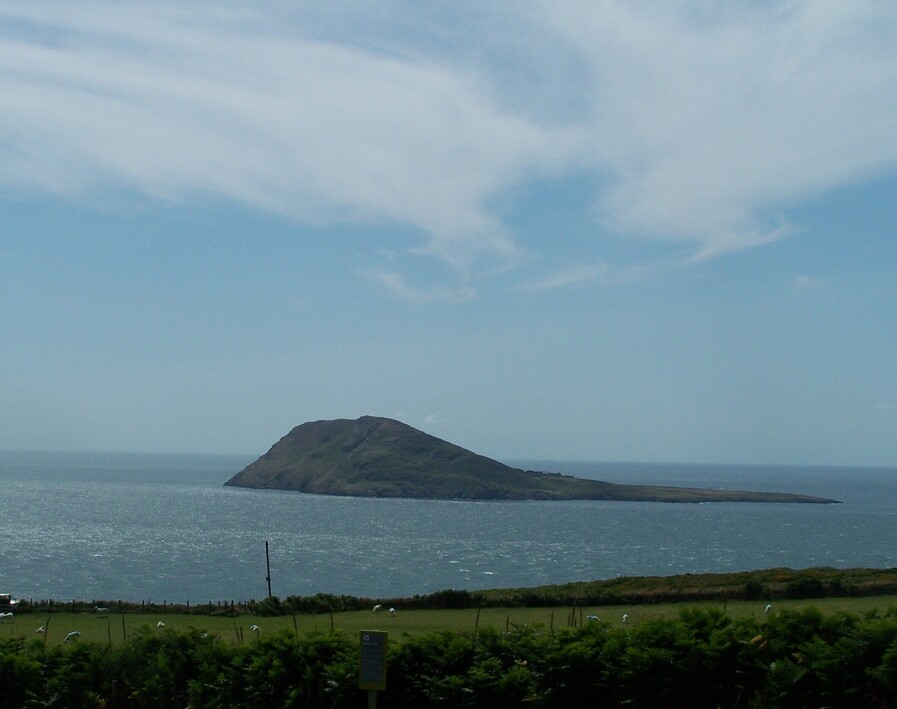
Crossing Bardsey Sound
Last night the weather changed, high winds and rain sweeping in from the West. This afternoon the wind has abated somewhat but its effects will still be working their way through and making themselves felt out on the water for some hours to come. So siting by the slipway waiting for the 4pm boat we’re expecting a bumpy ride back to the mainland. Surprisingly the simple act of putting on my waterproof jacket and trousers in readiness for the crossing seems to immediately calm the nervous anxiety and once we’ve loaded the luggage and securely fastened our life-jackets (about which the boatman has only half jokingly said “You need to wear these, ‘cos at the inquest they’ll ask why you weren’t!”) a sense of anticipation and excitement takes over.
Unlike the journey out a few days earlier, where we took a direct line, speeding across the flat open water, now we stay close to land, hugging the steep coast line of the East side of the island, till we reach the turning point where we head out in to the sound between island and mainland. The engine slows and we seem to climb up onto a moving plateau of water. It feels like going up on the crest of a wave but not dropping down the other side as you would expect with a succession of waves all running in the same direction. The various currents which converge here have the effect of trying to push a greater and greater volume of water into the space than there is actually room for, and hence the sense of it being pushed up above the level of the surrounding water. This plateau of water is now an infinitely complex interplay of wind initiated energies meeting, merging, colliding and travelling through each other, creating an ever shifting dynamic body of water constantly in a state of flux. It has become a liquid obstacle course, the fluid equivalent of a tank training course where the peaks and troughs keep moving and changing positions, constantly rearranging themselves in relation of each other. Watching the boatman negotiate his way across this flux, he is constantly adjusting the engine’s speed and boat’s direction, turning this way and that, so as to be working with the waves not fighting against them. In the most turbulent passages we slow even more and seem to weave a gently meandering path through the rising and falling hills and valleys.
On the other side of the sound we again sail close in to the rocky coastline. Here the waves are more consistent in rhythm and direction and we pick up speed, again taking a more direct line running in along with the waves. It is an extraordinary process to watch, like watching a master craftsman at work, an exhibition of highly skilled navigation and reading of the currents, a skill acquired by years of sailing those waters. Exhilarating – it never felt dangerous – just respect inspiring and a privilege to witness, a feeling which will stay with me for days afterwards.
There is something about the rhythm of travelling by sea and its dependency on the weather, the wind, the currents and tides that makes one aware of the rhythms of place and the different tempos associated with them. One travels with a different, more place specific, rhythm and tempo. While at sea it is very obvious and fluid, but it also applies to journeys on land and through different cultural domains. It took me a very long time to learn how to walk in the hills and mountains. It isn’t something that seems to get taught, (or if it is I clearly wasn’t paying attention that day, which might be true of a great many other things and other days). I remember the day out in the hills when I first learnt to walk up steep slopes, to find the speed of the slope, pretending to walk in slow motion as it got steeper, enjoying the playfulness of it rather than fighting against the steepness and the exertion. Enjoying the moment rather than focusing on the distance still to go. If you were on a bicycle you’d change to a lower gear trying to keep a constant output of energy, walking is the same, enjoying the easy rhythm of each step, finding the pace at which one could go all day. My dance teachers would have us run around the studio for 15 – 20 minutes at the start of each class. Focusing on the breath, being aware of the feet on the floor, staying soft in the knees and ankles, finding a comfortable easy rhythm that felt as though we could keep going at that pace all day. Out on the road if running it always felt a struggle as though one was trying to get somewhere, it would take several miles before it would settle into a groove; by contrast in the studio, going round and round, there was nowhere to go, it was simply about the process, inhabiting the moment, finding the ease of action, using the body’s natural rhythms and motions as effectively as possible.
Many of us drive to work, often at a ridiculous speed. The ability to do so has not lessened the time we spend commuting merely extended the distance we can or are prepared to go. When I first lived on the hill where I am now there was an old man who used to talk about walking to the gold mines to work when he was young, it’s a distance of about 6 or 7 miles so maybe 1½ to 2 hours each morning and evening. To us this seems really a long walk to go to work but nowadays plenty of people spend a similar amount of time commuting by car, train, bus or some combination of them in order to go maybe ten times further.
There is a clear tempo and rhythm to interacting with others. One of the things I remember most clearly from my music therapy training was my tutor talking about finding the tempo of different clients. He was referring specifically to working with acute psychiatric patients, with the idea that someone might be operating at a vastly accelerated tempo relative to most of us, while another might be functioning at an incredibly slowed down tempo and elongated time frame, and that finding these different tempos was a potential key to enabling some kind of meeting. In the intervening years I have come to feel this notion of speed or tempo as pertinent to lots of topics some of which are well known and documented, such as the speed at which you drill or cut different materials, and others which are more intuitive such as relating to other people, learning skills or explaining ideas or processes. We are multi layered temporal processes.
Contact
If you wish to contact me, please use the contact form below. Thank you.